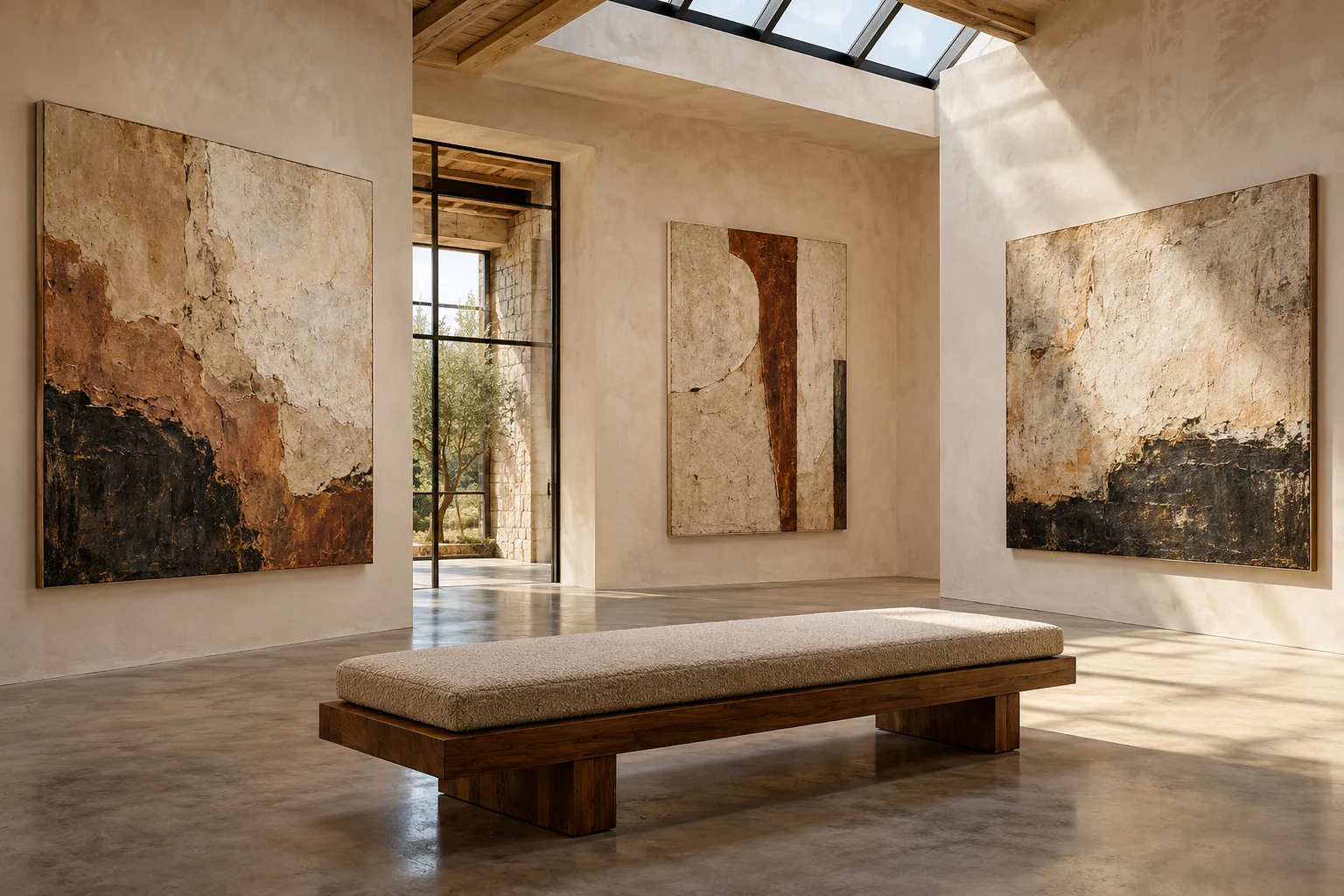
A jagged line of crimson cuts across a field of muted grey. The texture is thick, almost sculptural, catching the gallery light in ridges that cast tiny, sharp shadows. You might feel a sudden tension in your chest, or perhaps a sense of restless movement. These are your observations—the immediate, visceral response to what your eyes are actually seeing.
The Tension of Interpretation
Walking through a local exhibition often brings an unspoken expectation to "get it." There is a subtle pressure to decode the symbolism or to find the exact sentiment the artist intended to convey. We often look to the small white card beside the frame, searching for a key that unlocks the work. We want to know if the red line represents anger, a sunset, or a physical wound. This search for the "correct" meaning can turn a moment of quiet reflection into a stressful mental exercise.
For example, if you are standing before a large, abstract installation made of twisted copper wire, you might find yourself wondering if it is a commentary on industrial decay or a celebration of organic growth. If you cannot find the answer in the provided description, you might feel as though you have missed something essential. This creates a tradeoff: you can either focus on the internal dialogue triggered by the shapes and shadows, or you can focus on the external effort of matching your thoughts to the artist's stated biography.
Separating Sight From Statement
A meaningful way to navigate an art outing is to distinguish between your sensory input and the creator’s explanation. Your eyes report the scale, the color temperature, and the way the medium interacts with the room. The artist’s statement, when available, provides a different layer—a historical or personal context that exists alongside your experience rather than replacing it. One is a physical fact; the other is a narrative perspective.
If you find yourself struggling to connect with a particular piece, consider shifting your focus away from the "why" and back to the "what." Instead of asking what the artist meant, observe how the work occupies the space. Does it demand attention through volume, or does it retreat into the corner? Does the light hit the surface in a way that changes your mood?
Streamlining the Gallery Visit
For those who prefer to minimize decision fatigue on a weekend outing, the goal is to reduce the number of analytical hurdles you set for yourself. You do not need to form a definitive opinion on every piece you pass. You can choose to engage deeply with one work and simply acknowledge others as you move toward the exit.
If you are attending a guided tour or a specialized opening, you might ask the docent how the specific arrangement of the pieces is intended to guide the viewer's movement. By deciding beforehand that your primary role is that of an observer rather than a critic, you transform the gallery from a testing ground into a place of pure visual encounter.